The Ho Chi Minh Mausoleum, a monumental tribute to Vietnam’s revered revolutionary leader, President Ho Chi Minh, is an essential stop for any traveler to Hanoi. It’s more than just a historical site; it’s a place of profound national pride and a poignant reminder of Vietnam’s struggle for independence. To help you plan a truly meaningful visit, we’ve compiled a comprehensive guide based on our extensive experience.

The Ho Chi Minh Mausoleum, affectionately known as “Uncle Ho’s Mausoleum” (Lăng Bác), is centrally located within the expansive Ba Dinh Square. Its address is 2 Hung Vuong Street, Dien Bien Ward, Ba Dinh District, Hanoi. This prime location is steeped in history; it’s the very spot where President Ho Chi Minh read the Declaration of Independence on September 2, 1945, giving birth to the Democratic Republic of Vietnam. The Mausoleum is considered the soul of the nation and one of Hanoi’s most significant symbols.
Navigating to the Ho Chi Minh Mausoleum is quite convenient, regardless of your chosen mode of transport. The best route generally depends on your starting point within Hanoi.
If you’re departing from Hoan Kiem Lake, follow Trang Thi Street to Hoang Dieu, then Hoang Van Thu, and finally Hung Vuong Street, which will lead you directly to the Mausoleum. From the Temple of Literature & National University, take Chu Van An Street to Doc Lap, then Hoang Van Thu, and Hung Vuong. The roads are generally well-maintained and easy to follow, though peak hours can experience traffic congestion.
You can reach the Mausoleum by car, motorbike, or even enjoy a leisurely cyclo ride, which offers a charming perspective of the surrounding area. For those opting for public transport, several bus routes, including 09, 22, 23, 45, and 50, conveniently pass by the Ho Chi Minh Mausoleum.
Finding parking near the Mausoleum is a common concern for visitors. To accommodate guests, Hanoi has designated seven parking areas serving both the Mausoleum and the Ba Dinh historical and cultural complex. These include:
These parking facilities are spacious and offer ample room for vehicles, allowing you to explore the complex without worrying about your transportation.
The Ho Chi Minh Mausoleum operates on different schedules depending on the season:
Important Note: The Mausoleum is closed for visits on Mondays and Fridays. It also closes for annual maintenance, usually from September to December. It’s always advisable to check the official schedule or consult with your leading travel agency Singapore or local operator like MYCT VIET NAM TRAVEL for the most up-to-date information before your visit.
Access to the Ho Chi Minh Mausoleum and its surrounding areas, including Ba Dinh Square, is free of charge for both Vietnamese citizens and international visitors. There are no fees to pay to visit the Mausoleum or any other part of the complex.
A visit to the Ho Chi Minh Mausoleum complex offers a multitude of powerful and insightful experiences.
One of the most moving experiences at the Ho Chi Minh Mausoleum is witnessing the daily flag ceremony. Regardless of the weather, the solemn flag-raising ceremony takes place precisely at 6:00 AM in the summer and 6:30 AM in the winter each morning. The flag-lowering ceremony occurs nightly at 9:00 PM.
These ceremonies are performed with utmost precision and dignity by a guard of honor consisting of 37 highly selected soldiers, chosen for their height (1.7m or taller) and dignified bearing. The procession is led by the “Quyet Thang” military flag, followed by 34 honor guards, symbolizing the 34 initial soldiers of the Vietnam Propaganda and Liberation Army. As the national anthem, “Tien buoc duoi quan ky” (Marching Under the Military Flag), plays, the Vietnamese flag is slowly hoisted to the top of the 29-meter flagpole in front of the Mausoleum, billowing majestically in the wind. This moment evokes a deep sense of pride and reverence among all present.
Similarly, the flag-lowering ceremony takes place nightly at 9:00 PM. As the flag is slowly lowered in the vast expanse of Ba Dinh Square, it marks the close of another day in the capital. Both visitors and locals who happen to be in the vicinity during these ceremonies often pause, standing in solemn respect and singing the national anthem with profound emotion.
The journey to pay respects to President Ho Chi Minh begins at the entrance to the Ho Chi Minh Museum on Ngoc Ha Street. Visitors are required to form orderly queues and follow the guidance of the staff.
After passing through security checkpoints, you will proceed across Ba Dinh Square and into the Mausoleum itself. Inside, it’s crucial to adhere strictly to the staff’s instructions. Photography and videography are strictly prohibited within the chamber where President Ho Chi Minh’s body lies, and visitors are asked not to linger. The experience of standing before the preserved body of Uncle Ho is incredibly moving, a moment that words often fail to capture. It’s an opportunity for profound reflection and a deep sense of connection to Vietnam’s history.
The Ho Chi Minh Mausoleum complex is a comprehensive historical site that includes several other significant structures: the Ho Chi Minh Mausoleum, the Presidential Palace, Ho Chi Minh’s Stilt House, the Ho Chi Minh Museum, and the One Pillar Pagoda.
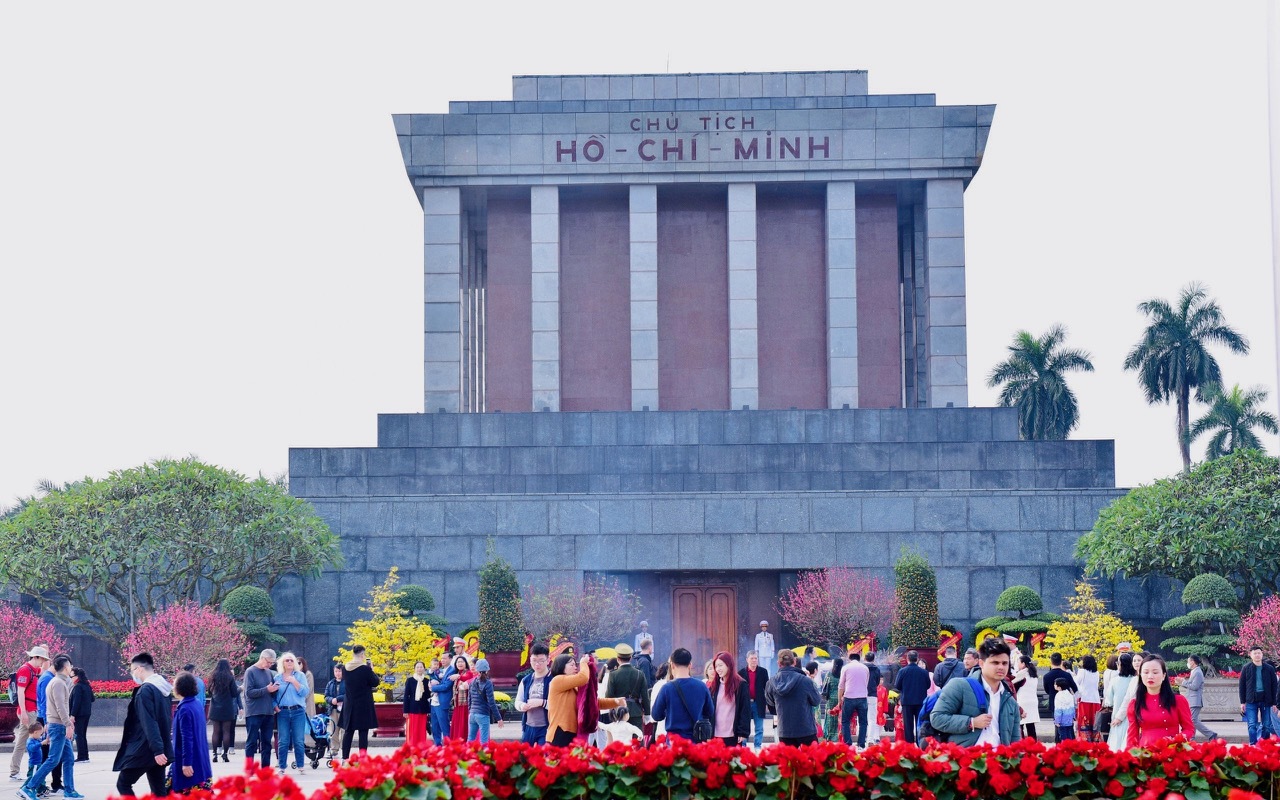
The Ho Chi Minh Mausoleum: Construction began in 1973 and was completed in 1975. This imposing and solemn structure stands 21.6 meters tall, featuring a grey-silver facade adorned with lush greenery. Both the exterior and interior are largely constructed from stone, with the main entrance clad in polished black stone. The lower section of the Mausoleum is paved with granite, forming a sturdy three-tiered base. The roof is gracefully designed with cross-cut lines, blending the neatness of modern architecture with the soft curves of traditional Vietnamese roofs. Inside, four rows of columns frame four deep red walls, marking the eternal resting place of President Ho Chi Minh.
The Presidential Palace: Part of the Mausoleum complex, the Presidential Palace was originally built as the residence for the Governor-General of Indochina. This grand yellow edifice, constructed in classical French architectural style with striking blue windows, stands out even from a distance. After the French left Vietnam in 1954, President Ho Chi Minh chose to work here until his passing in 1969. During his time at the Presidential Palace, Uncle Ho, along with the Central Party Committee and the Government, formulated crucial strategies and policies that guided Vietnam’s revolution, actively contributing to the building of socialism and the struggle for independence, freedom, and peace.
The Ho Chi Minh Presidential Palace historical site boasts a harmonious and verdant ecological landscape, featuring a crystal-clear lake, fruit gardens, ornamental plants, shade trees, and timber trees. This creates a picturesque and relaxing atmosphere for visitors. Today, the Presidential Palace serves as a venue for receiving high-ranking officials and hosting important state events.
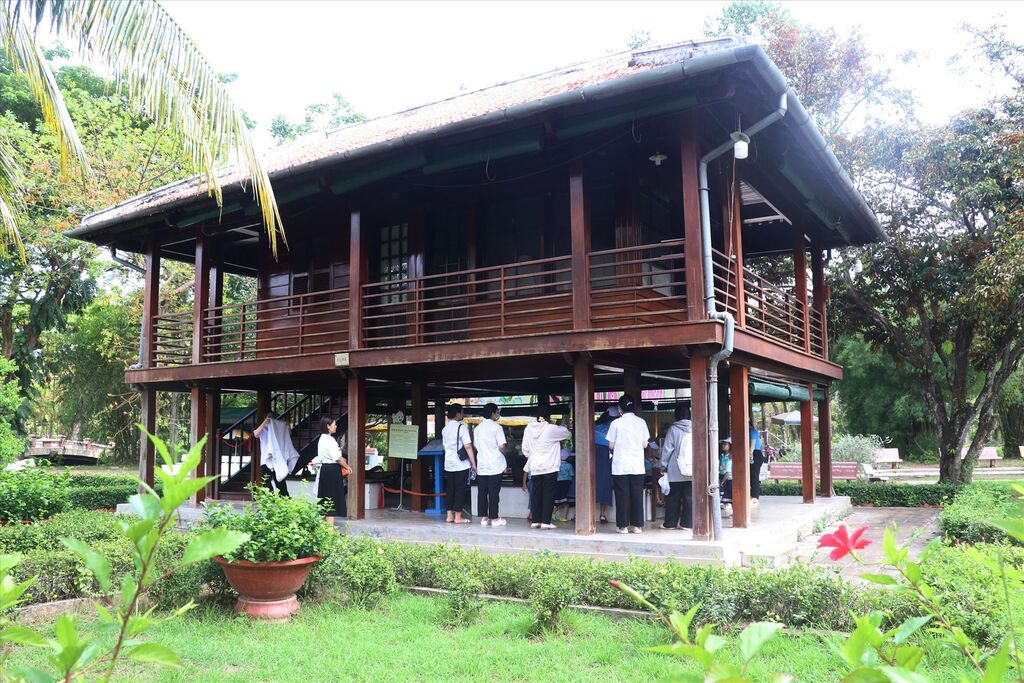
The stilt house has two levels with three small, simple rooms, reflecting Ho Chi Minh’s modest lifestyle. Each room, approximately 10 square meters, contains only a bed, table, chair, wardrobe, and bookshelf. His personal belongings are equally simple: a single blanket, a rush mat, a typewriter, and a palm fan. Visitors to this former residence of a head of state are invariably filled with reverence and admiration for his great character and his pure, simple way of life.
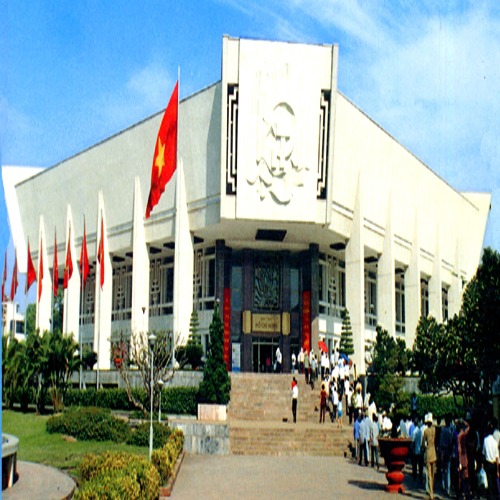
Ho Chi Minh Museum: Construction of the Ho Chi Minh Museum began in August 1985 and it was inaugurated five years later. It is the leading museum in the system of museums dedicated to President Ho Chi Minh across Vietnam. The museum’s design resembles a white lotus, symbolizing Uncle Ho’s pure life. Inside, art exhibits and artifacts comprehensively portray his life and revolutionary activities, alongside displays detailing the Vietnamese people’s struggles and victories under his leadership. A visit to the museum offers profound insights into President Ho Chi Minh’s life and immense contributions to the Vietnamese nation, deepening visitors’ understanding and appreciation.
One Pillar Pagoda: For a long time, the One Pillar Pagoda has been an iconic symbol of Hanoi, appearing in countless publications, magazines, and social media. Despite the ravages of time and conflict, the pagoda stands resilient, exuding a graceful elegance in the heart of the capital. The pagoda has undergone multiple renovations due to age and wartime damage.
Legend has it that the One Pillar Pagoda was built based on a dream of Emperor Ly Thai Tong (1028-1054). In his dream, he saw the Goddess of Mercy sitting on a lotus pedestal and was invited to join her. The emperor recounted his dream to the monk Thien Tue, who advised him to build a pagoda with a stone pillar and a lotus platform, as seen in the dream. The pagoda was named Dien Huu. During the reign of Emperor Ly Nhan Tong, the One Pillar Pagoda was expanded and beautified, with the addition of Lien Hoa Dai Lake, Bich Tri Lake, and a stupa. In 1954, the One Pillar Pagoda was destroyed during the war but was later rebuilt based on blueprints from the Nguyen dynasty, completed in 1955. Since then, the One Pillar Pagoda has been continually preserved as a national heritage site.
The One Pillar Pagoda is a testament to the sophistication and creativity of Vietnamese art, architecture, and sculpture. To reach the main shrine, visitors ascend 13 small steps. Another notable feature is the ancient Bodhi tree, brought from India and gifted to President Ho Chi Minh by President Rajendra Prasad during his visit in 1958. The tranquil surroundings, lush greenery, and serene atmosphere around the pagoda offer a sense of peace and relaxation.
Ba Dinh Square is vast, adorned with numerous trees, offering fresh air and an open, spacious environment. Here, you can comfortably take photos with the Mausoleum as your backdrop. Visitors should remember to follow staff instructions when taking pictures, avoiding unauthorized or inappropriate actions. Capturing these moments will create lasting memories of your visit to this significant historical site.
To ensure a respectful and smooth visit to the Ho Chi Minh Mausoleum, please be aware of the following regulations:
At MYCT VIET NAM TRAVEL, we believe that understanding these guidelines will help you have a respectful and fulfilling visit to the Ho Chi Minh Mausoleum. This iconic site is a cornerstone of Vietnam’s identity, offering a deep dive into the nation’s history and the enduring legacy of its beloved leader. We are committed to providing you with an enriching and seamless travel experience throughout Vietnam.
Ready to embark on your Vietnamese adventure, exploring historical landmarks, stunning natural wonders, and vibrant cultures? Contact MYCT VIET NAM TRAVEL today to customize your perfect tour package.

© Copyright 2026 Myct Vietnam Travel. All Rights Reserved.